
Stuck in the Loop: Understanding the Anxiety Maintenance Cycle (And How to Break Free)
By: Cierra Bailey
Registered Psychotherapist (Qualifying)
Anxiety
When anxiety takes over, our instinct is to protect ourselves. If heading to the grocery store triggers thoughts like “What if something goes wrong?”, avoiding the trip brings instant relief. It makes sense because our brains naturally want to keep us safe.
Here is the tricky part: the very strategies we used to escape anxiety often end up maintaining it. Avoidance provides short-term comfort, but it keeps the threat alive in the long run.
By understanding the Anxiety Maintenance Cycle, we can shift our focus from fighting anxiety to uncovering what is keeping it stuck and learning how to break free.
When Your Brain Misreads Danger
Instinctively, our brains are hardwired to protect us from discomfort and danger. This is the classic fight, flight, or freeze response, a primitive survival mechanism driven by the amygdala. Back in early human history, this alarm system kept us safe from physical threats like predators by pumping cortisol and adrenaline through our bodies, forcing us into high alert.
While our world has evolved, our brain’s survival wiring hasn’t fully caught up. It often struggles to distinguish between an actual physical threat and a perceived emotional one. As a result, harmless triggers like a sudden spike in heart rate, an uncertain work email, or an awkward social interaction can trigger the exact same biological alarm system as facing down a real danger. We end up misinterpreting uncomfortable feelings as immediate hazards.
Once this alarm trips, hypervigilance sets in. Your nervous system goes into overdrive, constantly scanning your thoughts, body, and surroundings for potential risk. Because your brain is actively hunting for threat, it inevitably finds something to worry about, effectively keeping the alarm ringing even when you are completely safe.
The Safety Traps – Avoidance & Safety Behaviors
When anxiety kicks in, we naturally try to protect ourselves by creating habits to stay safe.
The most common trap is avoidance: “If I don’t go, I won’t feel anxious.” Skipping the event brings immediate relief, but it accidentally sends a message to your brain: “I only made it through today because I ran away.”
When complete avoidance isn’t an option, we often rely on safety behaviors, doing the uncomfortable thing, but using a secret “crutch” to make it through. This might look like going to a social gathering, but clinging to your phone the whole night, constantly asking a friend for reassurance, or over-researching a venue so you know every possible exit route ahead of time.
This creates a sneaky dilemma:
- In the short term: It feels great. The safety net lowers your distress right away, making you want to rely on it again next time.
- In the long term: It tricks your mind into believing the situation was genuinely dangerous and that you only survived because you had that security blanket to lean on.
Instead of teaching your nervous system that you can handle uncertainty, safety behaviors leave you feeling dependent on the crutch.
The Maintenance Loop
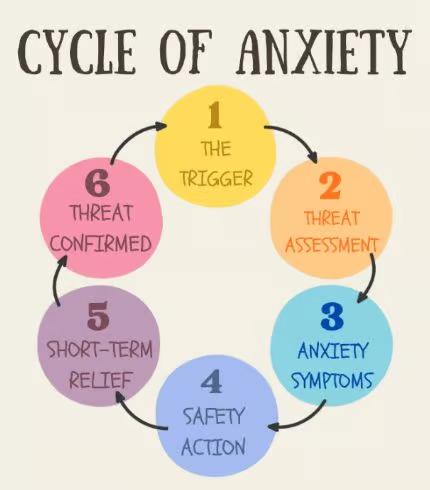
When you put all these pieces together, anxiety stops looking like a random wave of fear and reveals itself for what it really is: a predictable feedback loop.
Here is how the cycle plays out step-by-step:
- The Trigger: An internal body sensation (a flutter in your chest) or an external situation (an upcoming party).
- The Threat Assessment: Your brain instantly misinterprets the trigger: “What if something goes terribly wrong?”
- Anxiety Symptoms: Your body reacts with physical tension, a racing heart, or a wave of panic.
- The Safety Action: You quickly use a safety net or avoid the situation (you leave early, distract yourself, or seek constant reassurance).
- Short-Term Relief: Your nervous system settles down, giving you immediate comfort.
- The Long-Term Consequence: Your brain registers: “Phew, that was close! That situation really was dangerous.”
Because the brain thinks the danger was real, the alarm system gets set even tighter for next time—and the loop begins all over again.
Breaking the Cycle
Now that we understand the anxiety loop, how do we actually break free?
The shift begins when we change our goal. Instead of trying to eliminate anxiety entirely, focus on changing your relationship with it.
Breaking the loop means learning to sit with temporary discomfort without immediately reaching for avoidance or a safety net. When you stay in the situation, you show your brain that while anxiety is uncomfortable, it isn’t dangerous.
A great way to practice this is through behavioral experiments, small, gentle tests to challenge your assumptions:
- “What happens if I don’t ask for reassurance this time?”
- “What if I stay at the social event for 15 minutes without checking my phone?”
- “What if I go to the store without mapping out every exit beforehand?”
Finally, practice self-compassion. Retraining an overactive alarm system takes time and patience. When anxiety flares up, skip the self-judgment and offer yourself understanding instead: “It makes sense that I feel this way right now. My brain is learning a new response, and I can take this one step at a time.”
Final Thoughts
Navigating persistent anxiety isn’t easy, but remember, it persists not because you are broken, but because your internal alarm system is stuck in a protective loop, trying to keep you safe the only way it knows how.
Breaking free doesn’t require eliminating fear entirely, nor does it mean you have to fix yourself overnight. It starts with small, brave steps like learning to sit with uncertainty, gently testing your boundaries, and proving to yourself that you are far more capable of handling discomfort than your brain leads you to believe.
Unlearning these deeply wired patterns takes time, patience, and a whole lot of grace. You don’t have to do it alone. Working with a therapist can provide the tailored guidance, tools, and support you need to break the loop at your own pace.
The next time your anxiety alarm clock rings, try asking yourself: What if I gave myself permission to pause, breathe, and trust that I can handle this moment, just as I am?